
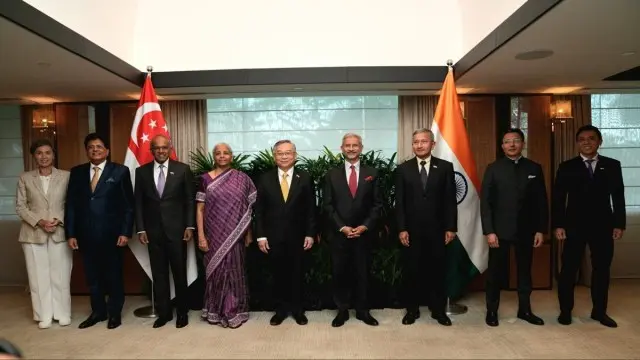

At the 4th India-Singapore Ministerial Roundtable (ISMR), delegations led by Singapore's DPM Gan Kim Yong and Indian Ministers S. Jaishankar, Nirmala Sitharaman, and Piyush Goyal expanded their Comprehensive Strategic Partnership across semiconductors, green shipping, workforce skilling, and food safety.
- The 4th India-Singapore Ministerial Roundtable (ISMR) reviewed bilateral ties across six core strategic pillars.
- Singapore is facilitating its precision engineering SMEs to integrate into India's semiconductor supply chains.
- A National Centre of Excellence for Advanced Manufacturing is being established in Chennai with ITEES Singapore.
- Bilateral pacts were concluded covering food safety (FSSAI-SFA), telecom regulation (TRAI-IMDA), and maritime heritage.
New Delhi / Singapore: Bilateral cooperation between India and Singapore achieved a major strategic milestone as both nations moved to accelerate supply-chain resilience, advanced workforce development, and clean energy transition under their Comprehensive Strategic Partnership. At the fourth India-Singapore Ministerial Roundtable (ISMR) held in Singapore, high-level ministerial delegations led by Singapore’s Deputy Prime Minister Gan Kim Yong and India’s ministerial leadership—including External Affairs Minister S. Jaishankar, Finance Minister Nirmala Sitharaman, and Commerce and Industry Minister Piyush Goyal—reviewed collaborative progress across key emerging pillars. Readers tracking bilateral industrial policy can access verified reports on our national economic news portal.
Semiconductor Ecosystems and Supply-Chain Integration
Building on the foundational 2024 Semiconductor Ecosystem Partnership Memorandum of Understanding (MoU), both governments reviewed significant private capital inflows into India's emerging fabrication and testing hubs. Singapore is actively facilitating the integration of its precision engineering small-and-medium enterprises (SMEs) and specialized equipment suppliers into the Indian market, establishing an end-to-end component manufacturing corridor. A dedicated 'Green Lane Initiative' for the semiconductor industry is also being operationalized to reduce cross-border regulatory friction.
Workforce Skilling and Advanced Manufacturing Centres
To meet the specialized talent demands of semiconductor fabrication and testing, bilateral initiatives are establishing advanced technical training infrastructure. A landmark project includes the development of the National Centre of Excellence (NCOE) for Advanced Manufacturing in Chennai, created in partnership with Singapore's ITE Education Services (ITEES). This institution will serve as a national benchmark for technical curriculum design and vocational skilling in high-tech fabrication.
Green Economy and Clean Shipping Corridors
Bilateral cooperation is expanding rapidly into sustainable maritime and energy networks. Both nations are formalizing plans for dedicated Green and Digital Shipping Corridors, focusing on zero-emission maritime fuels, green hydrogen supply chains, and digital port documentation clearance between Indian coastal hubs and Singapore.
Formal Accords in Food Safety, Maritime Heritage, and Telecom
The fourth ISMR dialogue concluded with key bilateral agreements:
- Food Safety and Trade: An MoU between the Food Safety and Standards Authority of India (FSSAI) and the Singapore Food Agency (SFA) to establish technical data exchanges and streamline agricultural food export approvals.
- Maritime Heritage Cooperation: An MoU between India's Ministry of Ports, Shipping and Waterways and Singapore's Ministry of Culture, Community and Youth to foster museum exchanges, including collaboration on the National Maritime Heritage Complex at Lothal.
- Telecom Regulation: A Letter of Intent (LoI) between the Telecom Regulatory Authority of India (TRAI) and Singapore's Infocomm Media Development Authority (IMDA) to share regulatory best practices across telecommunications and broadcasting.
Frequently Asked Questions
Ketan
adminPassionate journalist and digital news editor committed to delivering accurate, timely, and fact-checked news.
Related Articles

Latest Articles
PM Modi Conferred Uzbekistan's Highest Honour 'Ord...
Aug 30, 2026
IMD East India Heavy Rain Alert: Red Warning in Od...
Aug 30, 2026
Bihar Reservation Row: Chirag & Manjhi Spar Over C...
Aug 30, 2026
Mohan Bhagwat at MSG: 'Unity in Diversity' & Messa...
Aug 30, 2026
Comments (0)
Leave a Comment
No comments yet. Be the first to comment!