
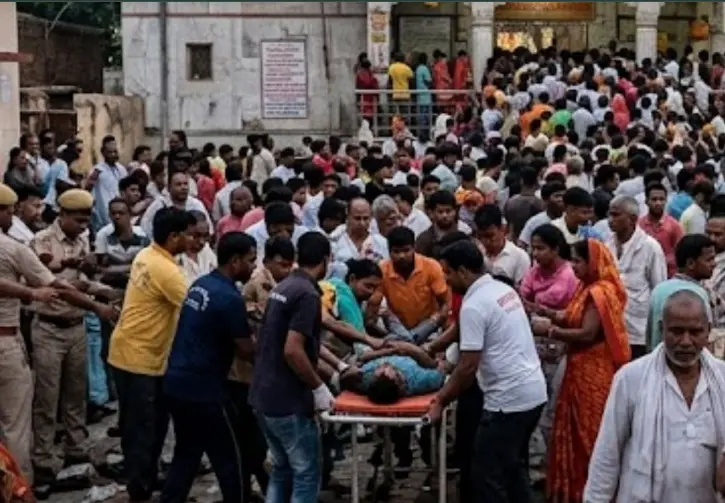

Seven devotees died and over a dozen were injured in a stampede at Bihar's Ashok Dham Temple in Lakhisarai on August 17, 2026, after a collapsed electric pole triggered a false electrocution rumour among a crowd of roughly 50,000 gathered for the third Monday of Shravan. Hours later, a separate stampede-like situation near Ujjain's Mahakaleshwar Temple complex, triggered by a similar electric-current rumour amid Nag Panchami crowds at the Nagchandreshwar Temple, left around 13 devotees injured, though no deaths were reported there. Both incidents underscore a recurring pattern of overcrowding-related tragedies at major Shiva temples during the Shravan season.
- Seven devotees died and over a dozen were injured in a stampede at Bihar's Ashok Dham Temple on August 17, 2026.
- A collapsed electric pole triggered a false electrocution rumour that caused the fatal crowd panic in Lakhisarai.
- Separately, around 13 devotees were injured in a stampede-like situation near Ujjain's Mahakaleshwar Temple complex the same day.
- The Ujjain incident coincided with Nag Panchami, when the Nagchandreshwar Temple opens for its once-a-year darshan.
- No deaths were reported in Ujjain, distinguishing it from the fatal Lakhisarai stampede.
- Both incidents were triggered by rumours of live electric current amid dense Shravan Monday crowds.
A Single Monday, Two Temples, One Tragic Pattern
Monday, August 17, 2026, turned into a day of heartbreak at two of India's most revered Shiva temples, more than 1,000 kilometres apart. In Bihar's Lakhisarai district, a stampede at the Ashok Dham Temple left at least seven devotees dead and more than a dozen injured. Hours later, a separate panic near Ujjain's Mahakaleshwar Temple complex in Madhya Pradesh sent at least 13 devotees to hospital. Both incidents shared an eerily similar trigger: a sudden rumour of live electric current sweeping through a densely packed crowd.
Lakhisarai: A Rumour, a Collapsed Pole, and a Rush That Turned Fatal
The tragedy in Bihar unfolded on the third Somwari (Monday) of the holy Shravan month, a day that had drawn an estimated 50,000 devotees to the Ashok Dham Temple for jalabhishek, the ritual offering of water to Lord Shiva. According to Lakhisarai District Magistrate Shailendra Kumar, the crowd swelled dramatically between 6:30 and 7:00 am, with the queue stretching back toward the Ashok Dham railway halt, where two trains happened to be stationed. Then came the moment that turned devotion into disaster: an electric pole, carrying a cable wire, collapsed. Though officials later confirmed no one was actually electrocuted, a false rumour that current was spreading through the crowd triggered instant, uncontrollable panic.
'My Wife Was Caught in the Crowd, I Couldn't Find My Daughter'
What followed was chaos. Devotees surged backward to escape the perceived danger, slamming into bamboo barricades lining a narrow, sloping passage toward the temple entrance. Witnesses described roughly 100 people pushing through barricades near the entrance as the structure gave way, sending people falling over one another. One witness recounted the terrifying moments when his wife was swept into the crush and he briefly lost track of his daughter in the crowd. Seven deaths have been confirmed so far, including several women: Manmala Devi (44), Rinku Devi (50), Hemlata Devi (55), and Lalita Devi, among others, with more than a dozen others injured and taken to Lakhisarai's Sadar Hospital. Authorities have not ruled out the toll rising further, as some of the injured remain under observation.
Political Reactions Pour In
Union Minister Rajiv Ranjan (Lalan) Singh expressed his condolences on X, describing how the crowd suddenly swelled and a rumour of a fallen live wire spread panic, leading to the stampede. Bihar Chief Minister Samrat Choudhary called the incident "extremely tragic and heart-wrenching," and confirmed that instructions had been issued for the swift and proper treatment of the injured. Notably, this is not the first tragedy at Ashok Dham Temple, a site that has seen crowd-related incidents before, raising renewed questions about crowd management infrastructure at one of Bihar's most popular Shiva shrines.
Ujjain: Panic Strikes on Nag Panchami
Nearly simultaneously, a very different but eerily similar scene played out at Ujjain's Mahakaleshwar Temple complex. The chaos centred on the Nagchandreshwar Temple, a shrine located on the upper floor of the Mahakaleshwar complex that opens to devotees for darshan only once a year, on Nag Panchami, which this year coincided with the third Monday of Shravan, doubling the crowd pressure. Near Harsiddhi Chauraha, a rumour spread that electric current was leaking from barricades close to a power distribution point. As devotees tried to move away from the perceived danger, crowd pressure built rapidly, and barricades reportedly collapsed under the strain.
Thirteen Hospitalised as Chaos Spreads Across the Complex
Around 13 devotees were rushed to Charak Hospital and the Ujjain District Hospital for treatment, according to local reports. Ujjain SP Pradeep Sharma confirmed that at least two people were hospitalised after complaining of nausea amid the crush. The injured came from across the region, including Hindu Bai, Sagar, and Lakshmibai from Ujjain itself, Sonam and Khushi from Gwalior, and Ansuya and her mother Mamata from Ganjbasoda. Crowd-related congestion was also reported at multiple other points around the temple complex, including Harsiddhi Temple Square, Bada Ganesh Temple, Neelkanth Square, and the route connecting Kark Raj Parking to the Harsiddhi entrance. Darshan was briefly suspended as police and administrative officials worked to bring the situation under control, before being resumed under revised crowd-management arrangements.
Fact-Check: What's Confirmed and What Isn't
Cross-checking against multiple independent reports (Outlook India, Telangana Today, PTC News, The Federal, Sunday Guardian, and News9 Live) confirms the core details of both incidents: the Lakhisarai death toll of seven with over a dozen injured, the electrocution-rumour trigger following a collapsed pole, and the timing on the third Monday of Shravan. For Ujjain, the figure of approximately 13 injured devotees, the Nag Panchami/Nagchandreshwar Temple context, and the electric-current rumour near Harsiddhi Chauraha are similarly well corroborated across sources. One important distinction worth noting: unlike Lakhisarai, no deaths have been reported in the Ujjain incident, only injuries, and Indian and Madhya Pradesh officials have specifically termed it a "stampede-like situation" rather than a stampede outright. Readers should also be aware that Ashok Dham Temple and Mansa Devi Temple in Haridwar have both seen serious stampede incidents in previous years, underlining a recurring pattern of overcrowding-related tragedies at major Shiva temples during the Shravan season, rather than this being an isolated one-off event.
A Recurring Monsoon Tragedy
Taken together, Monday's twin incidents highlight a grim and recurring seasonal pattern: massive, devotion-driven crowds converging on temples during Shravan's holy Mondays, often exceeding what temporary infrastructure like bamboo barricades and narrow passages can safely handle. With Shravan not yet over, officials at temples across North and Central India are likely to face renewed pressure to strengthen crowd-management protocols before the next big rush of devotees arrives.
Frequently Asked Questions
Ketan
adminPassionate journalist and digital news editor committed to delivering accurate, timely, and fact-checked news.
Related Articles



Latest Articles

PM Modi Conferred Uzbekistan's Highest Honour 'Ord...
Aug 30, 2026
IMD East India Heavy Rain Alert: Red Warning in Od...
Aug 30, 2026
Bihar Reservation Row: Chirag & Manjhi Spar Over C...
Aug 30, 2026
Mohan Bhagwat at MSG: 'Unity in Diversity' & Messa...
Aug 30, 2026
Comments (0)
Leave a Comment
No comments yet. Be the first to comment!