
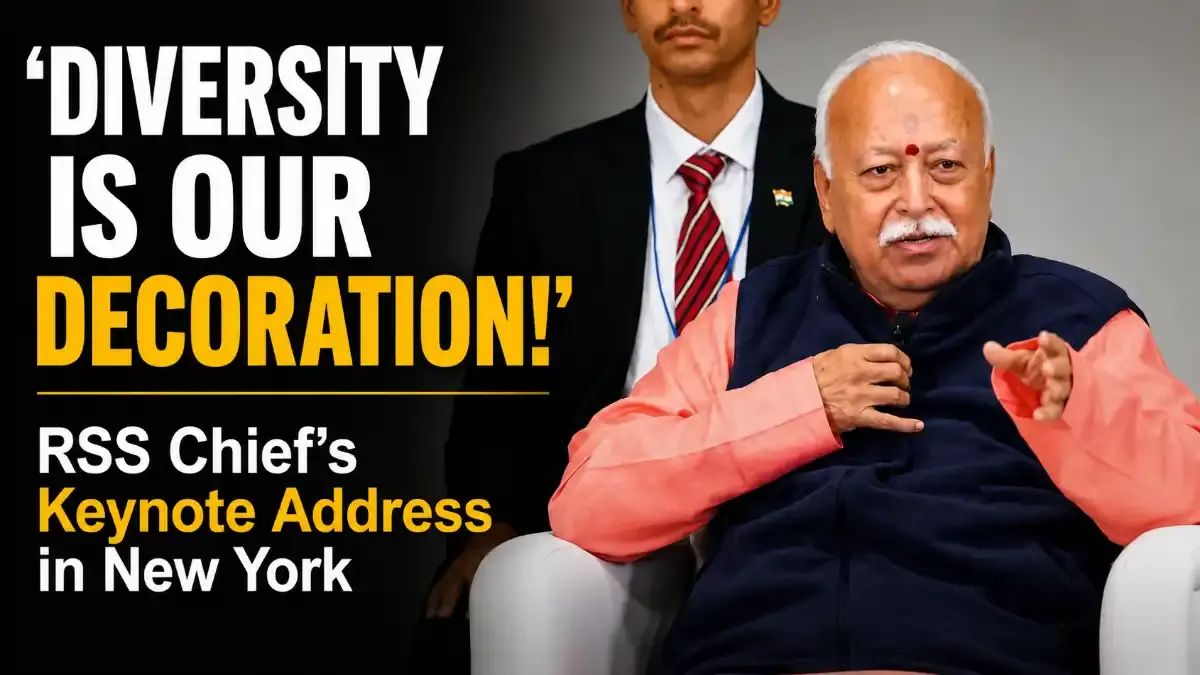
Addressing over 5,000 attendees at Madison Square Garden in New York during the Universal Oneness Celebration, RSS Chief Mohan Bhagwat emphasized Bharat's civilisational unity in diversity, inclusive Hindutva, and the primary duty of Indian-Americans towards their Karma Bhumi.
- RSS Chief Mohan Bhagwat addressed over 5,000 people at Madison Square Garden during the Universal Oneness Celebration.
- Contrasted Western pluralism with Bharat's 'unity in diversity', describing differences as the 'decoration of oneness'.
- Reiterated that a Hindu who believes there should be no Muslims in Bharat ceases to be a Hindu.
- Advised Indian-Americans to remain primarily loyal and dedicated to their Karma Bhumi (the US).
- Emphasized that enduring social change comes from social awakening and selfless service rather than political power alone.
New York: Addressing a gathering of over 5,000 members of the Indian-American diaspora, multi-faith representatives, and community leaders at the Infosys Theater inside Madison Square Garden (MSG), Rashtriya Swayamsevak Sangh (RSS) Sarsanghchalak Mohan Bhagwat outlined Bharat's civilisational philosophy at the Universal Oneness Celebration. The high-profile gathering, organized by the American Hindus for Engagement and Dialogue (AHEAD) Forum alongside interfaith groups, marked a milestone engagement during the RSS centenary-year global outreach tour across the United States, Canada, and the United Kingdom. For comprehensive global geopolitics, cultural diplomacy, and diaspora news, explore our international desk.
American Pluralism vs. Bharat’s 'Unity in Diversity'
In his keynote address, Bhagwat drew a distinction between Western models of pluralism and India's ancient civilisational worldview:
- Decoration of Oneness: While the United States frequently navigates coexistence through the framework of "pluralism", Bhagwat stated that Bharat’s core identity is anchored in "unity in diversity". He described diversity not as a source of division, but as the "decoration of oneness".
- Civilisational Destiny: Invoking Swami Vivekananda, he remarked that every nation carries a distinct mission, and Bharat’s destiny is to demonstrate how to practice and live universal oneness through service and mutual respect rather than mere preaching.
Ideological Stance on Hindutva and Inclusion
Addressing questions surrounding Hindu philosophy and national identity, Bhagwat reiterated his stance on inclusion:
"If you want to call yourself a Hindu, you must believe that all paths lead to the same goal. Every human being has inherent dignity... If any Hindu thinks that there should be no Muslim in Bharat, he ceases to be a Hindu."
He emphasized that true Hindutva recognises multiple spiritual paths to the same universal truth and mandates the protection of every individual's fundamental dignity.
Message to Indian Diaspora: 'Loyalty to Karma Bhumi'
Bhagwat offered direct counsel to non-resident Indians (NRIs) and Indian-Americans regarding their civic obligations abroad:
- Prioritising the Adopted Homeland: Emphasising the principle of Karma Bhumi (the land where one works and resides), he urged community members to remain steadfastly loyal and dedicated to the United States.
- Janma Bhumi Connection: Contributing to Janma Bhumi (one's ancestral homeland, India) is natural, but must follow the complete fulfillment of one's civic duties to their adopted nation.
Philosophy of Dharma, Materialism, and Social Transformation
Highlighting the limits of purely materialistic pursuits, Bhagwat defined Dharma as a holistic sustaining principle—a balance enabling individuals, society, and the environment to progress together in harmony. "How much we earn is not important; how much we distribute is important," he noted, calling on citizens to build sustainable models of giving back to society.
Reflecting on governance, he observed that modern politics is often constrained by narrow self-interest ("me and mine"), arguing that structural societal transformation cannot be achieved through political power alone, but must emerge from grassroots social awakening, selfless service, and unified public consciousness.
Frequently Asked Questions
Ketan
adminPassionate journalist and digital news editor committed to delivering accurate, timely, and fact-checked news.
Related Articles


Latest Articles
IMD East India Heavy Rain Alert: Red Warning in Od...
Aug 30, 2026
Bihar Reservation Row: Chirag & Manjhi Spar Over C...
Aug 30, 2026
Mumbai Milk Price Hike: Tabela Milk to Cost ₹102/L...
Aug 30, 2026
PM Modi in Tashkent: Tricolour Illumination, Rakhi...
Aug 30, 2026
Comments (0)
Leave a Comment
No comments yet. Be the first to comment!