
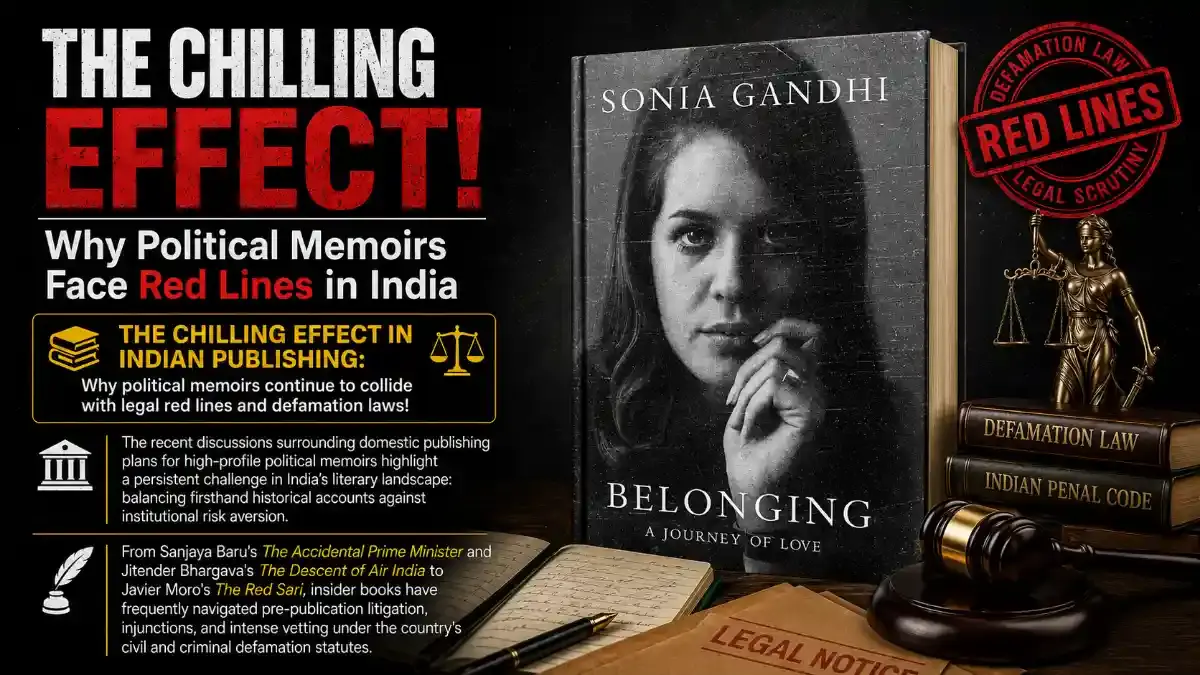

An editorial analysis examining the recurring friction between political memoirs and India's legal landscape, focusing on how defamation provisions under the Bharatiya Nyaya Sanhita drive preemptive self-censorship and risk aversion among commercial publishers.
- The controversy over Sonia Gandhi's memoir 'Belonging' highlights recurring publishing challenges for political non-fiction in India.
- Past insider accounts by Sanjaya Baru, P.C. Parakh, and Jitender Bhargava faced defamation suits, injunctions, or withdrawal.
- Provisions under the Bharatiya Nyaya Sanhita (BNS) make defending defamation claims across multiple jurisdictions costly and complex.
- Disparities between domestic and international editions point to institutional risk aversion among Indian publishing subsidiaries.
New Delhi: The controversy surrounding Penguin Random House India stepping back from the domestic release of Sonia Gandhi’s upcoming memoir, Belonging: A Journey of Love, has exposed a structural fault line in Indian publishing: the growing conflict between primary political history and corporate self-censorship. Reports indicating that friction arose over proposed editorial redactions regarding sensitive political commentary, institutional references to the RSS, and key border developments reflect a decades-long pattern in the country's literary ecosystem. For in-depth investigative analysis on legal policy, media governance, and institutional accountability, explore our national editorial and policy portal.
A Precedent of Pre-Publication Gags and Injunctions
The friction surrounding contemporary political retrospectives follows a well-documented history of legal challenges and pre-emptive withdrawals in the Indian market:
- The Perils of Insider Memoirs: In 2014, former media adviser Sanjaya Baru’s The Accidental Prime Minister and former coal secretary P.C. Parakh’s Crusader or Conspirator? faced intense pushback from political establishments for documenting executive decision-making and coalition dynamics.
- Outright Pulverisation of Print Runs: In 2014, Bloomsbury India withdrew and pulped copies of former Air India executive director Jitender Bhargava’s book The Descent of Air India following criminal defamation proceedings filed by former civil aviation minister Praful Patel.
- Cross-Border Publication Disparities: Even unauthorized biographies have faced prolonged legal limbo. Javier Moro’s biographical account of Sonia Gandhi, The Red Sari, was delayed for over five years in India due to legal threats before finally being released in 2015.
Defamation Laws and Institutional Risk Aversion
A primary driver of publishing risk aversion is the statutory architecture governing defamation in India. Under the Bharatiya Nyaya Sanhita (BNS) (specifically Sections 356 and 357, which succeeded Sections 499 and 500 of the Indian Penal Code), defamation remains actionable as both a civil tort and a criminal offense.
For international publishing houses operating in India, the prospect of defending multiple concurrent private complaints across distant district courts presents severe financial and administrative burdens. When global parent imprints—such as Alfred A. Knopf in the United States—proceed with uncut, unredacted editions while their Indian subsidiaries seek extensive legal sanitization, it illustrates how legal exposure creates structural disparities in access to information.
Preserving Historical Records in a Constitutional Democracy
Political memoirs serve as vital primary historical records, documenting internal governance, policy debates, and executive decision-making. When publishers rely on extensive preemptive sanitization, the public historical record is diminished. Fostering a robust democratic square requires an environment where leaders, bureaucrats, and public figures can publish their accounts without the chilling effect of operational disruption or protracted litigation.
Frequently Asked Questions
Ketan
adminPassionate journalist and digital news editor committed to delivering accurate, timely, and fact-checked news.
Related Articles


Latest Articles

PM Modi Conferred Uzbekistan's Highest Honour 'Ord...
Aug 30, 2026
IMD East India Heavy Rain Alert: Red Warning in Od...
Aug 30, 2026
Bihar Reservation Row: Chirag & Manjhi Spar Over C...
Aug 30, 2026
Mohan Bhagwat at MSG: 'Unity in Diversity' & Messa...
Aug 30, 2026
Comments (0)
Leave a Comment
No comments yet. Be the first to comment!