
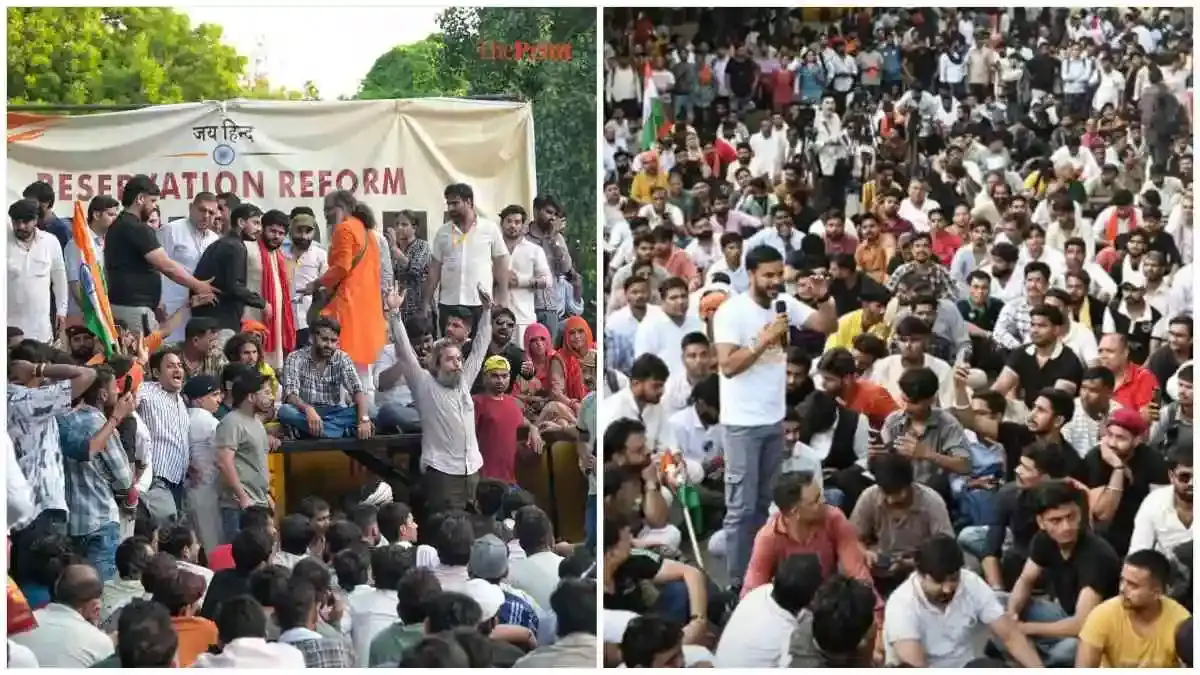

Delhi Police and Rapid Action Force personnel detained several protesters at Jantar Mantar on August 21, 2026, after the Instagram-driven 'Reservation Hatao Andolan' movement defied its Delhi Police-approved venue at Ramlila Maidan and gathered instead at Jantar Mantar. Hundreds of demonstrators, drawn from states including Bihar, Uttar Pradesh, Karnataka, and Rajasthan, demanded that reservation in jobs and education be based on economic criteria rather than caste, along with rollback of the UGC roster system and a sunset clause for reservation policy. The standoff escalated into the evening before police cleared the site, disrupting traffic across central Delhi and reigniting India's long-standing debate over caste-based reservation.
- Hundreds of protesters gathered at Jantar Mantar under the 'Reservation Hatao Andolan' banner, defying the Delhi Police-approved venue of Ramlila Maidan.
- Demonstrators demanded that reservation be based on economic criteria rather than caste, along with rollback of the UGC roster system.
- The movement, an Instagram page with 5.6 million followers, organised its first major physical protest on August 21, 2026.
- As protesters refused to disperse past permitted hours, Delhi Police and RAF detained dozens and eventually cleared the site.
- The protest triggered traffic restrictions across central Delhi and reignited India's long-running debate over caste-based reservation.
An Instagram Campaign Spills Onto the Streets
Jantar Mantar, long a fixture for public protest in the heart of Delhi, saw fresh turmoil on Friday, August 21, 2026, as hundreds of demonstrators gathered under the banner of 'Reservation Hatao Andolan' to demand sweeping changes to India's reservation system. The movement, which began as an Instagram page campaigning against the UGC Act and the SC/ST (Prevention of Atrocities) Act, has amassed some 5.6 million followers online, and organisers say the Friday gathering marked its first major push from social media mobilisation onto the streets.
Wrong Venue, Right in the Capital's Heart
The protest's location became a flashpoint in itself. Delhi Police had issued a no-objection certificate permitting a peaceful demonstration of up to 500 people at Ramlila Maidan until 4 pm, not Jantar Mantar. According to the organisers, however, permission had originally been sought for Jantar Mantar a full month in advance, only for the venue to be abruptly switched to Ramlila Maidan around noon on the day of the protest itself, a claim the group aired publicly on X, alleging the last-minute change was an attempt to blunt their movement's visibility. Whatever the reason, protesters chose to defy the approved venue and gathered instead at Jantar Mantar, where Delhi Police said no permission had been granted for any assembly, procession, or demonstration.
What the Protesters Are Demanding
Carrying banners, posters, and saffron flags, demonstrators, drawn from states including Bihar, Uttar Pradesh, Karnataka, and Rajasthan, raised slogans against caste-based reservation, including calls of "Aarakshan gareeb ko mile, jaati ko nahi" (reservation should go to the poor, not to caste). The protest's core demand is that eligibility for government jobs, educational admissions, and welfare schemes be determined by economic hardship, disability, orphan status, or family circumstances such as being the family of a martyr, rather than caste or religion. Organisers have also pushed for the rollback of the UGC's roster system, the removal of caste-related fields from government forms and applications under a proposed "One Nation, One Identity" framework, and additional structural changes including a "one family, one reservation, one time" rule, periodic review of reservation policy, and a sunset clause to eventually phase out caste-based quotas altogether.
Standoff Escalates as Evening Sets In
Tension built through the afternoon as the crowd, which some reports place in the hundreds and others in the thousands, remained at the site well past the administratively permitted protest hours. Security had been visibly tightened around Jantar Mantar even before the protest began, anticipating a large turnout. As dusk approached, with many protesters refusing repeated police requests to disperse, authorities moved in more forcefully, reinforcing Delhi Police personnel with additional Rapid Action Force (RAF) units. Visuals from the scene showed police detaining a large number of protesters, the majority of them men, as the situation was gradually brought under control. Delhi Police confirmed that Jantar Mantar was eventually cleared, though the exact number detained varies across reports, with figures ranging from several dozen upward. The protest also disrupted traffic across parts of central Delhi, with restrictions and diversions imposed around the demonstration site for much of the day.
A Debate That Cuts Both Ways
The protest has reignited one of India's oldest and most contentious policy debates. Supporters of the movement argue that decades after independence, reservation should evolve toward an economic-need-based model that they say would more fairly serve genuinely disadvantaged citizens regardless of caste. Critics, including many who support the existing system, counter that caste-based reservation exists specifically to redress centuries of documented social and structural discrimination that economic criteria alone cannot capture, and that diluting it risks undermining hard-won protections for historically marginalised communities. Both sides of this debate were visible in the public reaction to Friday's protest, underscoring how unresolved and emotionally charged the reservation question remains in Indian public life.
What Happens Next
With Jantar Mantar cleared and detained protesters processed by Delhi Police, attention now turns to whether 'Reservation Hatao Andolan' will organise further demonstrations, and how authorities will respond to a movement that has shown it can mobilise large numbers through social media alone. Given the scale of online support behind the campaign, Friday's events may prove to be an opening chapter rather than a conclusion to this particular chapter of India's long-running reservation debate.
Frequently Asked Questions
Ketan
adminPassionate journalist and digital news editor committed to delivering accurate, timely, and fact-checked news.
Related Articles
Latest Articles
IMD East India Heavy Rain Alert: Red Warning in Od...
Aug 30, 2026
Bihar Reservation Row: Chirag & Manjhi Spar Over C...
Aug 30, 2026
Mohan Bhagwat at MSG: 'Unity in Diversity' & Messa...
Aug 30, 2026
Mumbai Milk Price Hike: Tabela Milk to Cost ₹102/L...
Aug 30, 2026
Comments (0)
Leave a Comment
No comments yet. Be the first to comment!