
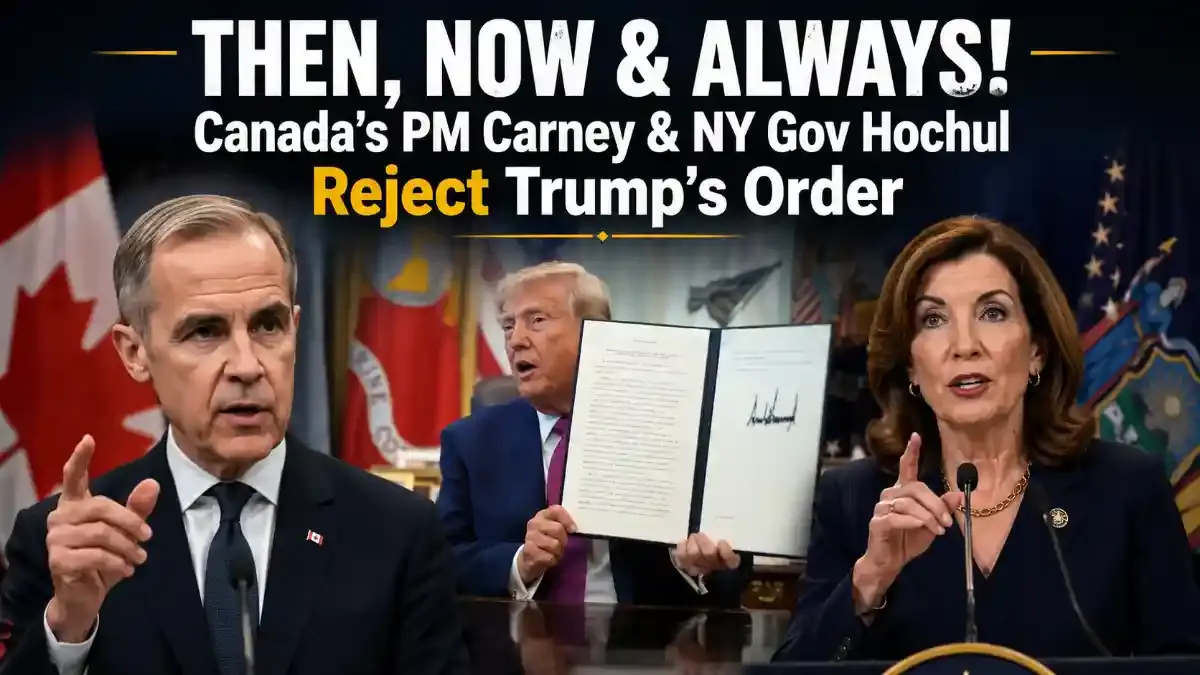

US President Donald Trump has signed an executive order renaming Lake Ontario to 'Lake America' within US federal records amid escalating trade tensions and 50% reciprocal tariffs with Canada. The unilateral measure has been rejected by Canadian Prime Minister Mark Carney, Ontario Premier Doug Ford, and New York Governor Kathy Hochul.
- US President Donald Trump signed an executive order renaming Lake Ontario to 'Lake America' across US federal databases.
- The order is legally binding only within US federal agencies and carries no international jurisdiction over Canada or global mapmakers.
- Canadian Prime Minister Mark Carney rejected the move, affirming the lake's 400-year-old Indigenous Wendat heritage.
- New York Governor Kathy Hochul and Ontario Premier Doug Ford both announced they will not adopt the new name.
- The naming dispute escalates a bilateral trade conflict marked by reciprocal 50% tariffs between the US and Canada.
Washington / Ottawa: In an unprecedented diplomatic and symbolic escalation amid a deteriorating cross-border trade conflict, US President Donald Trump has signed an executive order directing all federal agencies and the Board on Geographic Names (BGN) to officially rename Lake Ontario as "Lake America". The unilateral directive, signed in the Oval Office, follows a complete breakdown in bilateral trade negotiations and the implementation of reciprocal 50% tariff hikes between Washington and Ottawa. For continuous real-time analysis of international trade disputes and diplomatic relations, explore our global geopolitics and trade desk.
The Executive Order: Federal Scope and Jurisdictional Limits
Titled "Honoring the American history of the Great Lakes and renaming Lake Ontario as Lake America," the executive directive mandates the US Department of the Interior to update the Geographic Names Information System (GNIS), federal cartographic databases, and official administrative records within 30 days:
- Domestic Legal Boundary: The directive is strictly enforceable within US federal departments and domestic mapping systems. It possesses zero international legal authority and cannot compel the Canadian government, international hydrographic institutions, or global cartographers to alter designations.
- White House Justification: Signing the order beside a map relabeled "Lake America," Trump claimed the US provides the overwhelming share of Great Lakes security, environmental funding, and icebreaker deployment while alleging that Canada has engaged in unfair trade practices.
- Precedent: The move mirrors an earlier executive order by the administration that redesignated the Gulf of Mexico as the "Gulf of America" across federal registries.
Canadian Leadership and Regional Governors Push Back
The symbolic renaming provoked immediate condemnation across Canadian political leadership and US border states:
"The name Lake Ontario comes from the Wendat word Ontari'io, which, appropriately, means 'the lake is beautiful, the lake is big.' The name is more than 400 years old, predating both the Confederation of Canada and the Declaration of Independence... We know that America is changing. Their trading relationships, their foreign policies, their national monuments, their hydronyms. Canadians also know that naming reality means calling it Lake Ontario — then, now and always."— Mark Carney, Prime Minister of Canada
Provincial and state leadership also rejected the federal redesignation:
- Ontario Premier Doug Ford: Dismissed the decree as posturing, affirming that the water body will remain Lake Ontario "to Canadians and the rest of the world. Now and forever".
- New York Governor Kathy Hochul: Directly opposed the federal order on social media, declaring that "New York won't be calling it that," while highlighting severe economic disruptions faced by upstate farmers and exporters due to cross-border trade friction.
Escalating Trade War and Shared Water Treaties
The naming dispute comes against a backdrop of severe economic confrontation:
- Tariff Retaliation: The US administration imposed 50% tariffs on approximately $20 billion worth of Canadian imports, including dairy, steel, aluminum, and manufactured goods. In response, Canada announced retaliatory counter-tariffs of up to 50% across hundreds of US consumer goods and industrial components.
- Shared International Waters: Under the historic 1909 Boundary Waters Treaty, Lake Ontario is an internationally shared resource—with roughly 52% of its surface area situated in Canada and 48% in New York state—governed bilaterally through the International Joint Commission (IJC).
Frequently Asked Questions
Ketan
adminPassionate journalist and digital news editor committed to delivering accurate, timely, and fact-checked news.
Related Articles

Latest Articles

Maharashtra Grants 1-Year Breather for Auto & Cab...
Aug 28, 2026
Raksha Bandhan 2026 Nationwide Celebrations Trains...
Aug 28, 2026
Chandra Grahan & Raksha Bandhan: Sutak Kaal Rules...
Aug 28, 2026
Nepal Flash Floods: 469 Dead, Secondary Lake Breac...
Aug 28, 2026
Comments (0)
Leave a Comment
No comments yet. Be the first to comment!