
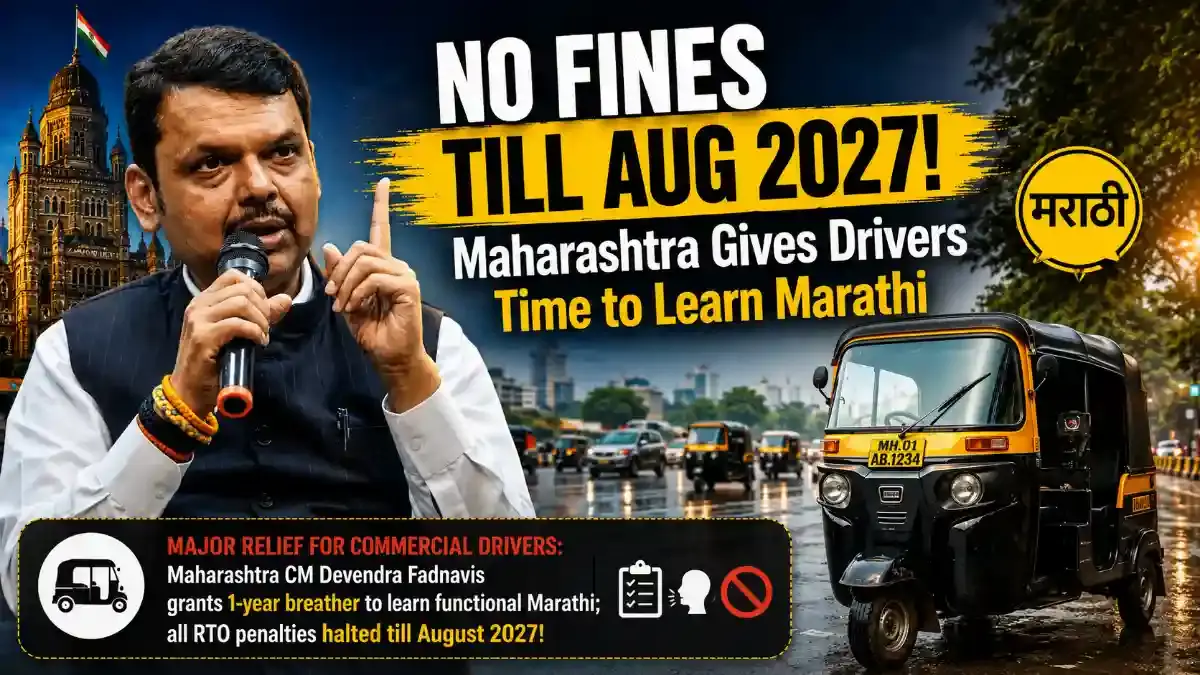

Maharashtra Chief Minister Devendra Fadnavis has announced a one-year grace period until August 2027 for auto-rickshaw and taxi drivers to acquire basic proficiency in Marathi, putting an immediate halt to all RTO fines, badge suspensions, and permit cancellations while rolling out free state-sponsored language learning classes.
- Maharashtra Chief Minister Devendra Fadnavis granted a 1-year grace period (until August 2027) for auto and taxi drivers to learn basic Marathi.
- All RTO fines, license cancellations, and badge suspensions for language non-compliance have been halted.
- The government will organize free spoken-language classes and distribute bilingual learning materials for daily transit communication.
- The rule applies across all major municipal corporations, including Mumbai, Pune, Thane, and Nashik.
Mumbai: In a decisive policy intervention providing substantial relief to thousands of commercial passenger vehicle operators across the state, Maharashtra Chief Minister Devendra Fadnavis announced a one-year grace period for auto-rickshaw, black-and-yellow taxi, and app-based cab drivers to acquire basic, functional proficiency in Marathi. The state government confirmed that all punitive measures—including monetary fines, show-cause notices, badge suspensions, and permit cancellations—will remain paused until August 2027. Instead of coercive enforcement, the administration will collaborate with transport unions and literary bodies to organize structured learning workshops and distribute conversational study materials. For continuous reporting on state governance, transport policy, and urban infrastructure, explore our Maharashtra news portal.
Key Highlights of the Government Directive
The state administration has outlined a supportive transition framework to facilitate language learning without jeopardizing driver livelihoods:
- 12-Month Grace Period: Commercial drivers across Maharashtra have been granted until August 2027 to develop working conversational skills for day-to-day passenger interactions.
- Zero Coercive Action: Regional Transport Offices (RTOs) have been directed to freeze license suspension procedures, badge revocations, and penalty drives for language non-compliance.
- Institutional Learning Support: The Maharashtra Transport Department, in coordination with regional literary organizations, will conduct free spoken-language classes and provide bilingual phrasebooks focusing on transit vocabulary, fare discussions, directions, and emergency terminology.
- Statewide Application: The directive applies uniformly across major municipal corporation limits and industrial hubs—including Mumbai, Pune, Thane, Pimpri-Chinchwad, and Nashik—which employ large numbers of interstate migrant drivers.
Background: Shift from Rigid Inspections to Educational Support
The language requirement stems from the Maharashtra Motor Vehicles Rules, 1989, which stipulates that commercial passenger vehicle operators must possess a working knowledge of the state's official language. Earlier this month, the transport department under Shiv Sena minister Pratap Sarnaik launched a statewide inspection drive across 58 RTOs, serving show-cause notices to over 4,000 drivers who failed language screenings. The rigid compliance window created severe anxiety among drivers and led to localized transport strikes across the Mumbai Metropolitan Region (MMR).
Addressing the growing unrest, a delegation representing auto-rickshaw and taxi unions—led by BJP transport wing chief Haji Arfat Shaikh—met Chief Minister Fadnavis at Sahyadri Guest House to request additional learning time. The union representatives emphasized that while drivers respect Maharashtra's cultural ethos and are eager to learn Marathi, many are older individuals with limited formal education for whom a 30-day crash deadline was unrealistic.
"A delegation of auto and taxi drivers met me and requested additional time to learn Marathi. Most of them are of different age groups and left their studies long ago, so they require more time. The government has accepted their demand. No action will be taken against them during this one-year period as they have themselves come forward and expressed willingness to learn."— Devendra Fadnavis, Chief Minister of Maharashtra
Political & Policy Perspectives
The decision balances linguistic preservation with the protection of migrant livelihoods across the state:
- CM Devendra Fadnavis (BJP): Intervened to provide a 1-year reprieve, emphasizing a supportive educational approach rather than administrative confrontation.
- Dy CM Eknath Shinde (Shiv Sena): Highlighted positive voluntary integration after distributing language completion certificates to over 20,000 drivers in Borivali who completed training modules.
- Transport Minister Pratap Sarnaik (Shiv Sena): Accepted the Chief Minister's extension while maintaining that compliance will be strictly reviewed after the grace period, remarking that drivers conducting business in the state should speak the local language.
- Driver Unions & Transporters: Welcomed the shift from aggressive penalization to structured training modules, pledging full participation in government-organized language batches.
Frequently Asked Questions
Ketan
adminPassionate journalist and digital news editor committed to delivering accurate, timely, and fact-checked news.
Related Articles

Latest Articles
Trump Renames Lake Ontario to 'Lake America' Amid...
Aug 28, 2026
Raksha Bandhan 2026 Nationwide Celebrations Trains...
Aug 28, 2026
Chandra Grahan & Raksha Bandhan: Sutak Kaal Rules...
Aug 28, 2026
Nepal Flash Floods: 469 Dead, Secondary Lake Breac...
Aug 28, 2026
Comments (0)
Leave a Comment
No comments yet. Be the first to comment!