
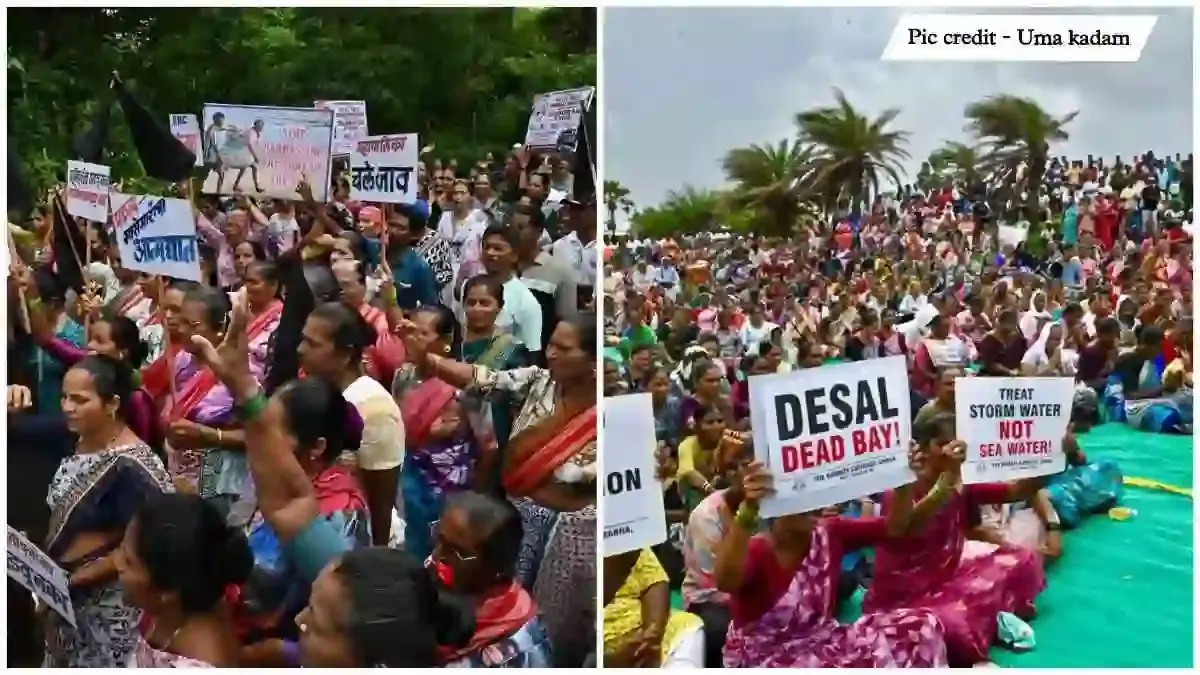

Over 2,500 coastal residents and Koli fishers held a mass demonstration at Manori Cliff against the BMC's proposed 200-400 MLD desalination plant, demanding its cancellation over threats of toxic brine discharge, ecological damage, and livelihood loss.
- Over 2,500 traditional fishers and coastal residents staged a mass protest at Manori Cliff (Bandongar).
- Key concerns center on hyper-saline brine discharge creating marine dead zones and destroying fish breeding grounds.
- The project threatens the primary livelihood of over 15,000 inhabitants across Manori, Gorai, Madh, and Uttan.
- Protesters and heritage groups also highlighted risks to Bandongar's prehistoric Middle Stone Age archaeological site.
Mumbai: Grassroots resistance along Mumbai's northern coastline intensified on Friday as more than 2,500 traditional Koli fishers, indigenous residents, and civil society groups gathered at Manori Cliff (locally known as Bandongar) to demand the immediate cancellation of the Brihanmumbai Municipal Corporation's (BMC) multi-crore seawater reverse osmosis (SWRO) desalination project. Organised under the leadership of the Maharashtra Macchimar Kruti Samiti, the National Fishworkers' Forum (NFF), and the Gorai Machimar Sahakari Sanstha, the demonstration highlighted deep-seated anxieties over marine biodiversity loss, coastal livelihood destruction, and environmental heritage damage.
Marine Ecological Risks and Hyper-Saline Brine Discharge
The municipal civic body aims to generate 200 million litres per day (MLD) of potable water in Phase 1 (expandable to 400 MLD) to drought-proof Mumbai's urban supply. However, marine biologists and fishing associations have raised severe concerns regarding the environmental fallout from returning hyper-saline wastewater (brine) back into the sea:
- Creation of Ecological Dead Zones: The daily discharge of chemical-laden, hyper-concentrated brine threatens to elevate nearshore salinity levels, suffocating plankton populations and disrupting fragile marine food webs.
- Destruction of Breeding Grounds: Fishers reported that preliminary exploratory drilling has already damaged rocky coastal patches and reefs where local fish species spawn, severely diminishing daily catches.
- Microbial and Larval Mortality: High-velocity intake systems risk pulling in fish eggs, fingerlings, and juvenile marine life, mirroring adverse impacts documented in other coastal desalination facilities.
Severe Threat to Coastal Livelihoods and Culture
According to state marine fisheries census data, over 70% of households across Manori, Gorai, Madh, and Uttan rely entirely on artisanal fishing, boat repairs, net-weaving, and retail fish markets. Community leaders emphasized that more than 15,000 coastal inhabitants face economic displacement if traditional fishing grounds are cordoned off or ecological yields collapse.
Heritage Concerns Over Geo-Archaeological Landmark
The proposed site at Bandongar holds recognized historical significance. Archaeological excavations previously uncovered Middle Stone Age (microlith) flint tools on the hill overlooking Manori beach, establishing human presence and prehistoric tool-making settlements dating back 10,000 to 15,000 years. Heritage advocates and local village welfare bodies argue that heavy industrial development and tunnel-boring shafts will permanently alter this irreplaceable cultural and geographical landscape.
Demands for Independent Environmental Audits and Dialogue
Protesting villagers alleged a complete absence of transparent public consultation, noting that mandatory public hearings and comprehensive Marine Environmental Impact Assessments (MEIA) were bypassed. While civic authorities maintain that intake tunnels extending into the sea will minimize nearshore impacts, the fishing unions have demanded an immediate cessation of all pre-project works until comprehensive independent scientific reviews and direct community consultations are conducted.
Frequently Asked Questions
Ketan
adminPassionate journalist and digital news editor committed to delivering accurate, timely, and fact-checked news.
Related Articles



Latest Articles

PM Modi Conferred Uzbekistan's Highest Honour 'Ord...
Aug 30, 2026
IMD East India Heavy Rain Alert: Red Warning in Od...
Aug 30, 2026
Bihar Reservation Row: Chirag & Manjhi Spar Over C...
Aug 30, 2026
Mohan Bhagwat at MSG: 'Unity in Diversity' & Messa...
Aug 30, 2026
Comments (0)
Leave a Comment
No comments yet. Be the first to comment!