
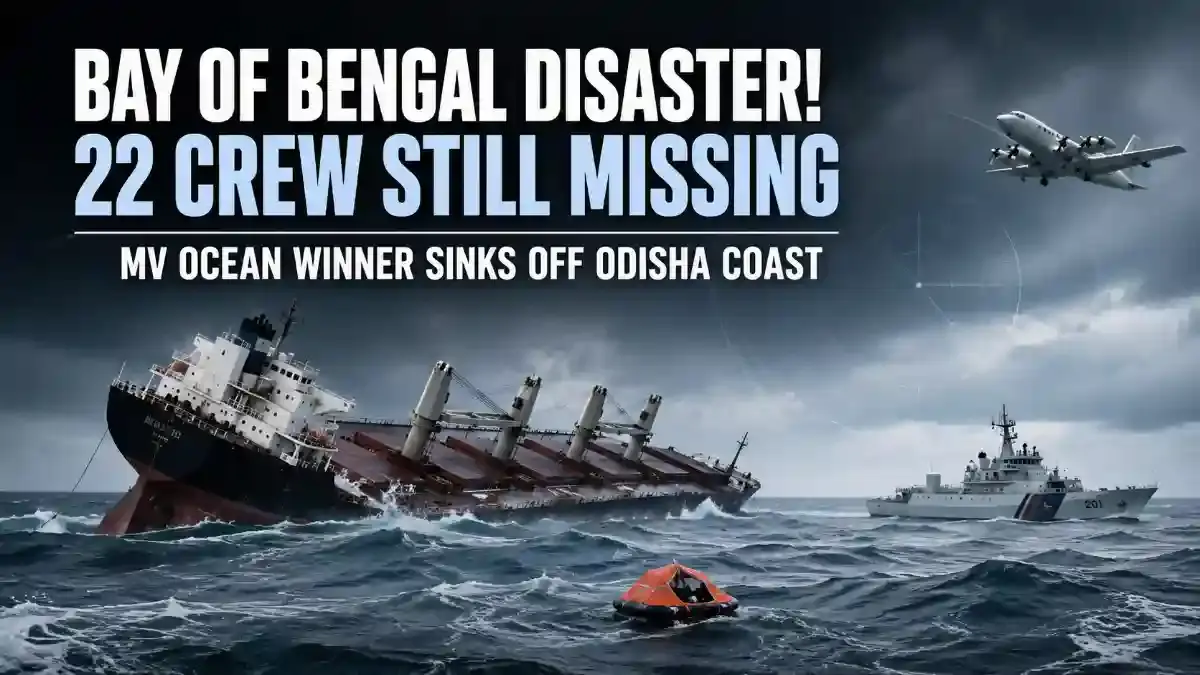

A Panama-flagged bulk carrier, MV Ocean Winner, carrying iron ore to Singapore sank 240 nautical miles off Odisha's Paradip coast. While two crew members were rescued from liferafts by a passing commercial vessel, the Indian Coast Guard and Navy have deployed three ships and a P-8I aircraft to search for the remaining 22 missing mariners.
- Panama-flagged bulk carrier MV Ocean Winner sank 240 nautical miles off the Odisha coast in the Bay of Bengal.
- Two crew members were rescued from liferafts by merchant tanker MT Aisopos; 22 crew members remain missing.
- The 24-member crew includes 20 Chinese, 3 Myanmar, and 1 Bangladeshi nationals.
- Indian Coast Guard deployed ships ICGS Varad, ICGS Anmol, and ICGS Vijit alongside a Navy P-8I surveillance aircraft.
Bhubaneswar / Paradip: A massive joint search-and-rescue (SAR) operation has been launched across the central Bay of Bengal by the Indian Coast Guard (ICG) and the Indian Navy after the Panama-flagged bulk carrier MV Ocean Winner sank approximately 240 nautical miles southeast of Odisha's Paradip coast. The 225-metre-long bulk vessel had departed Paradip Port laden with iron ore fines bound for Singapore before abruptly losing communication and sinking. Two crew members were recovered alive from liferafts by a diverted commercial tanker, while an intensive air-sea search continues for the remaining 22 missing crew members, predominantly Chinese nationals. Readers tracking maritime security and regional developments can follow live updates on our national breaking news portal.
Distress Timeline and Emergency Rescue Mobilisation
According to maritime authorities, MV Ocean Winner (IMO 9145530) sailed from Paradip Port on the night of August 20. Contact with the vessel was lost on Saturday, August 22, prompting the vessel's management operator, Victory Star Group Co. Ltd, to issue an urgent distress alert to the Maritime Rescue Coordination Centre (MRCC) in Sri Vijaya Puram (formerly Port Blair) at 11:48 AM.
MRCC immediately activated the International Safety Net (ISN) protocol, broadcasting urgent coordinates and diverting commercial vessels transiting the international shipping lane. The nearby crude tanker MT Aisopos reached the search grid and successfully rescued two survivors from two separate floating liferafts at around 8:00 PM.
Air-Sea Search Assets Deployed Across the Bay of Bengal
To locate the remaining 22 missing mariners across challenging monsoon swells, Indian defence and maritime agencies mobilized frontline operational assets:
- Indian Coast Guard Fleet: Offshore patrol vessels ICGS Varad and ICGS Anmol were deployed to the search datum, with ICGS Vijit sailing from Sri Vijaya Puram to reinforce surface grid sweeps.
- Naval Aerial Surveillance: The Indian Navy's Eastern Naval Command redeployed a Boeing P-8I Long-Range Maritime Reconnaissance Aircraft to execute extensive radar and electro-optical sweeps over the maritime exclusion zone.
- Crew Demographics: The 24-member crew comprised 20 Chinese nationals, three Myanmar nationals, and one Bangladeshi national. Respective consular authorities and maritime administrations have been formally notified.
Cargo Liquefaction Risks and Maritime Safety Protocols
While an official maritime investigation will establish the exact sequence leading to the rapid loss of buoyancy, maritime safety specialists point to recurring vulnerabilities associated with shipping bulk iron ore fines during the South Asian monsoon season. Under heavy wave action and moisture content exceeding the Transportable Moisture Limit (TML), fine granular mineral cargo can undergo dynamic liquefaction—shifting from a solid state into a viscous fluid within cargo holds. This sudden cargo shift causes severe loss of transverse stability, leading to rapid vessel capsizing with minimal warning.
The incident highlights India's critical responsibility as a primary search-and-rescue provider along the busiest mercantile corridors of the Indian Ocean Region, alongside the urgent need for stringent pre-loading moisture testing at mineral export terminals across the eastern seaboard.
Frequently Asked Questions
Ketan
adminPassionate journalist and digital news editor committed to delivering accurate, timely, and fact-checked news.
Related Articles

Latest Articles

Trump Renames Lake Ontario to 'Lake America' Amid...
Aug 28, 2026
Maharashtra Grants 1-Year Breather for Auto & Cab...
Aug 28, 2026
Raksha Bandhan 2026 Nationwide Celebrations Trains...
Aug 28, 2026
Chandra Grahan & Raksha Bandhan: Sutak Kaal Rules...
Aug 28, 2026
Comments (0)
Leave a Comment
No comments yet. Be the first to comment!