
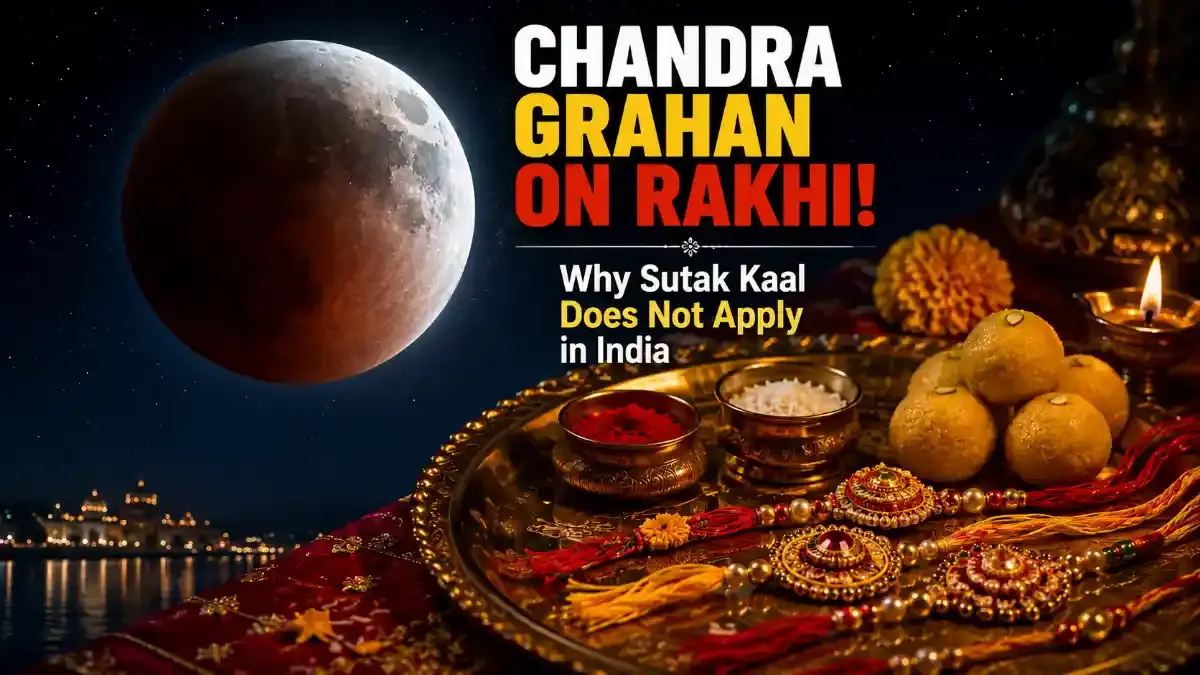

A deep partial lunar eclipse occurred on Raksha Bandhan between 6:53 AM and 12:31 PM IST. As the celestial event was invisible in India due to daytime planetary alignment, astronomical and Vedic authorities confirmed that Sutak Kaal is not applicable, allowing nationwide festive celebrations to proceed without interruption.
- A deep partial lunar eclipse occurred between 6:53 AM and 12:31 PM IST, coinciding with Raksha Bandhan.
- Because the phenomenon occurred during daylight hours and below the horizon, it was invisible across India.
- Panchang authorities and astronomers confirmed that Sutak Kaal is not applicable in India.
- Temples remained open and festive Rakhi ceremonies proceeded normally nationwide.
New Delhi: Millions of households celebrating Raksha Bandhan across the country witnessed a rare celestial occurrence on Friday as a deep partial Chandra Grahan (Lunar Eclipse) coincided with the auspicious full moon (Purnima) day. The celestial event spanned between 6:53 AM and 12:31 PM IST. However, leading astronomical institutions, planetary observatories, and Vedic Panchang authorities clarified that because the eclipse transpired during broad daylight when the Moon remained well below the local horizon across the subcontinent, Sutak Kaal is not applicable in India. This official clarification ensured that traditional festive rituals, temple darshans, and Rakhi tying ceremonies proceeded without disruption nationwide. For live updates on cultural observances and scientific phenomena, explore our national news portal.
Astronomical Mechanics and Planetary Timeline
According to planetary data and observational logs, the deep partial lunar eclipse progressed through distinct phases:
- Penumbral and Umbral Contact: The Moon entered the Earth's shadow beginning at 6:53 AM IST, reaching its peak partial obscuration during mid-morning hours before concluding at 12:31 PM IST.
- Daytime Phenomenon: Due to the planetary alignment occurring while the Sun was high in the sky across Indian longitudes, the Moon was not physically visible above the horizon anywhere within the country.
- Global Observational Visibility: The eclipse was visible across the Americas, parts of Western Europe, and regions flanking the Pacific and Atlantic oceans where nighttime prevailed during the event's progression.
Vedic Panchang Norms and Sutak Exemption
Under established astrological and Vedic traditions, the observance of Sutak Kaal—a nine-hour pre-eclipse period of ritual restraint that traditionally dictates the closure of temple sanctums and the deferral of auspicious ceremonies—applies exclusively to geographic locations where the eclipse is physically visible (Drishta Grahan).
Scholars and head priests confirmed that because the eclipse was invisible across all Indian states, no religious restrictions, dietary curbs, or festive deferrals were required. Consequently, temples remained open for daily worship, and families celebrated Raksha Bandhan smoothly during the designated auspicious Shubh Muhurat windows throughout the day.
Surging Public Interest and Social Media Trends
The simultaneous occurrence of the lunar eclipse and Raksha Bandhan sparked widespread curiosity and public engagement across digital platforms. Search engines and social media networks registered high volumes of queries regarding auspicious timings, planetary impacts, and ritual norms. Online platforms saw active conversations under trending hashtags including #ChandraGrahan2026, #LunarEclipse, and #RakshaBandhan as citizens sought scientific and astrological clarifications.
Frequently Asked Questions
Ketan
adminPassionate journalist and digital news editor committed to delivering accurate, timely, and fact-checked news.
Related Articles



Latest Articles

Trump Renames Lake Ontario to 'Lake America' Amid...
Aug 28, 2026
Maharashtra Grants 1-Year Breather for Auto & Cab...
Aug 28, 2026
Raksha Bandhan 2026 Nationwide Celebrations Trains...
Aug 28, 2026
Nepal Flash Floods: 469 Dead, Secondary Lake Breac...
Aug 28, 2026
Comments (0)
Leave a Comment
No comments yet. Be the first to comment!