
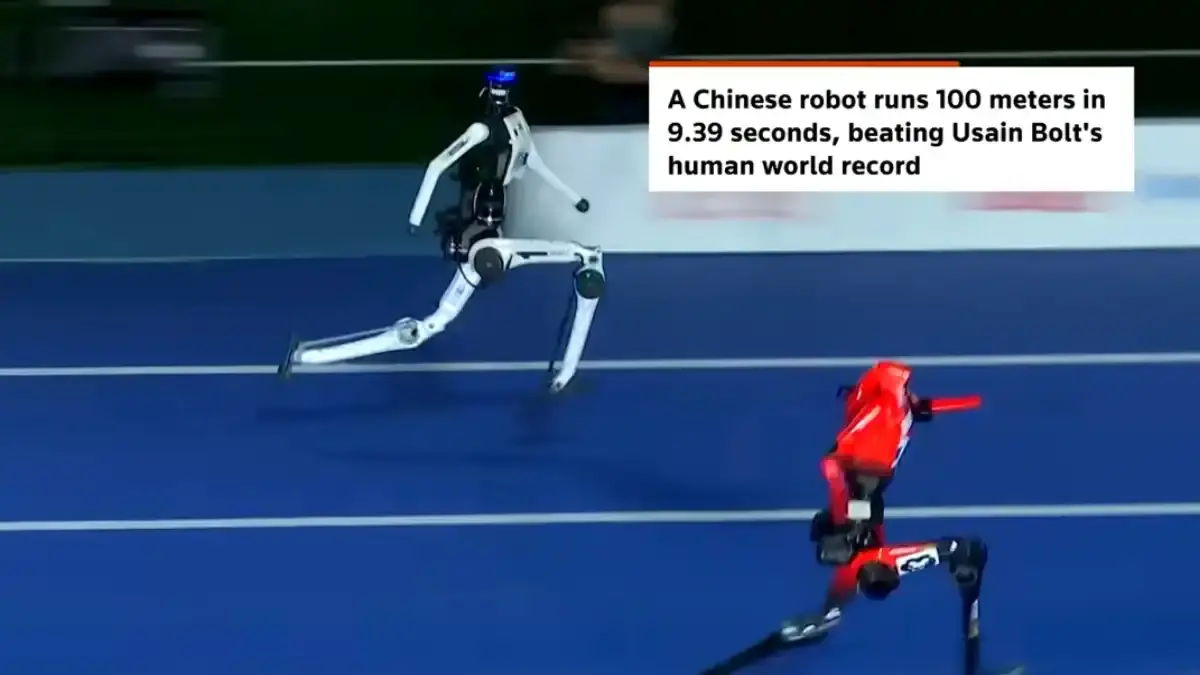

At the 2nd World Humanoid Robot Games in Beijing, Chinese bipedal humanoid robots eclipsed human world records, with Tiangong Ultra recording a 9.39-second 100-metre sprint and X-Humanoid jumping 2.88 metres, showcasing major leaps in dynamic actuators and reinforcement learning.
- Chinese humanoid robot Tiangong Ultra clocked 9.39 seconds in the 100m sprint, beating Usain Bolt's 9.58-second mark.
- A bipedal jumping robot from X-Humanoid cleared 2.88 metres in the high jump, eclipsing Javier Sotomayor's 2.45m record.
- Over 2,056 robots from 666 teams across 16 nations participated in the 2nd World Humanoid Robot Games in Beijing.
- Deceleration and dynamic balance remain engineering challenges, with sprint units crashing into foam barriers post-finish.
Beijing: In a historic milestone showcasing the accelerating capabilities of dynamic robotics, Chinese bipedal machines eclipsed iconic human athletic benchmarks during the opening sessions of the 2nd World Humanoid Robot Games at Beijing's National Speed Skating Oval. The multi-day championship brought together more than 2,056 robots from 666 engineering teams across 16 countries, competing across 51 categories spanning athletics, dynamic dance, and precision industrial operations. Readers following global technology breakthroughs and AI governance can track live reports on our global tech news desk.
Shattering Usain Bolt's 100-Metre World Record
The track-and-field events witnessed an unprecedented performance in the 100-metre sprint heat. Tiangong Ultra, an advanced bipedal system engineered by the Beijing Humanoid Robot Innovation Center, crossed the finish line in an astonishing 9.39 seconds. The feat surpassed Jamaican sprint legend Usain Bolt's historic human world record of 9.58 seconds, established at the 2009 World Athletics Championships in Berlin.
In the same heat, rival humanoid robot Lightning—co-developed with consumer electronics manufacturer Honor—recorded a time of 9.47 seconds after achieving a peak velocity of 14.5 m/s during preparatory trial runs. The dramatic speed marks exponential progress compared to the inaugural 2025 tournament, where the winning sprint time stood at 21.50 seconds.
Standing High Jump Benchmark Eclipsed at 2.88 Metres
The robotic performance gains extended beyond horizontal velocity into vertical propulsion. A bipedal jumping unit developed by Beijing-based startup X-Humanoid successfully cleared a standing high jump bar set at 2.88 metres. The jump surpassed Cuba's Javier Sotomayor’s longstanding 1993 human high jump record of 2.45 metres, as well as the previous 0.95-metre humanoid benchmark set in 2025.
Deceleration Mechanics and Real-Time Balance Hurdles
Despite record-breaking propulsion and high-torque joint motors, the trials underscored critical mechanical challenges regarding deceleration and kinetic balance control. Both sprinting robots lacked dynamic braking systems capable of managing momentum at terminal velocity, crashing directly into foam barrier cushions beyond the finish line before being retrieved by technician stretchers. Other competitor units experienced joint lockups or lost stability during rapid trajectory transitions, highlighting the engineering gap between raw linear acceleration and real-time human biomechanical adaptability.
Strategic Industrial and Geopolitical Implications
The athletic showcase aligns with China's national industrial roadmap prioritizing humanoid robotics as a core strategic sector. Advanced actuators, lightweight carbon-composite limbs, and deep reinforcement learning algorithms developed for athletic agility are being ported directly into manufacturing assembly lines, hazardous emergency response, and commercial logistics. The development comes as global powers intensify supply-chain scrutiny and technical standardization in advanced robotics.
Frequently Asked Questions
Ketan
adminPassionate journalist and digital news editor committed to delivering accurate, timely, and fact-checked news.
Related Articles




Latest Articles

Trump Renames Lake Ontario to 'Lake America' Amid...
Aug 28, 2026
Maharashtra Grants 1-Year Breather for Auto & Cab...
Aug 28, 2026
Raksha Bandhan 2026 Nationwide Celebrations Trains...
Aug 28, 2026
Chandra Grahan & Raksha Bandhan: Sutak Kaal Rules...
Aug 28, 2026
Comments (0)
Leave a Comment
No comments yet. Be the first to comment!