
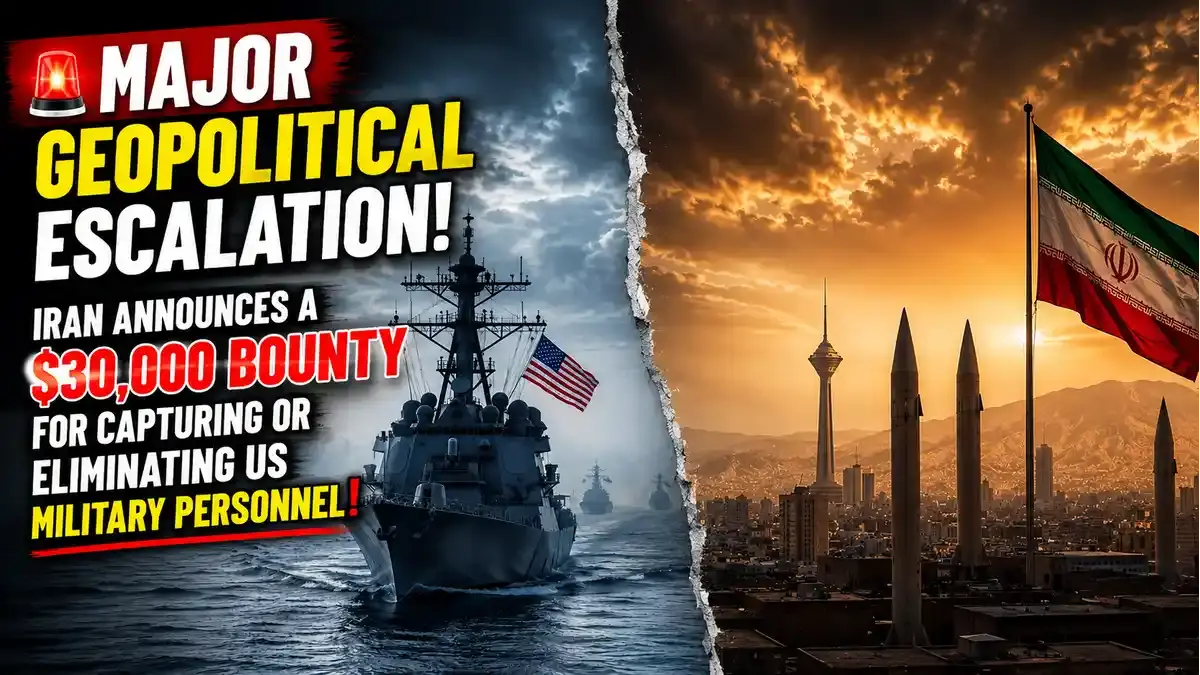

Iranian Army Commander-in-Chief Amir Hatami announced a $30,000 bounty on US military personnel, increasing the reward to $60,000 for women, escalating geopolitical rhetoric and security alerts across the Middle East.
- Iran's military announced a $30,000 bounty for capturing or killing US soldiers.
- The reward is doubled to $60,000 if the act is carried out by an Iranian woman.
- Army Chief Amir Hatami cited citizen contributions under a 'financial jihad' framework.
- Tehran reiterated demands for the complete withdrawal of US forces from the Persian Gulf and Strait of Hormuz.
Tehran: Tensions between the United States and the Islamic Republic of Iran escalated sharply after the Iranian military announced a financial reward of $30,000 (approximately 5 billion tomans) for anyone who captures or eliminates an American military service member. The announcement, delivered by Iranian Army Commander-in-Chief Major General Amir Hatami via state-run news agency IRNA, introduces an alarming new dimension to the protracted confrontation between Washington and Tehran. For real-time geopolitical coverage and global security updates, visit our international breaking news desk.
Double Reward for Women and 'Financial Jihad' Campaign
In his official address, Hatami stated that the bounty program was established in response to a massive volume of public requests and civilian donations intended to support Iran's national defense through a 'financial jihad'. He further announced that the prize money would be doubled to $60,000 if the capture or elimination of an American soldier is carried out by an Iranian woman.
"Anyone who kills or captures and hands over an invading American military personnel will receive a reward equivalent to $30,000 or 5 billion tomans from the Islamic Republic of Iran's Army. Courageous Iranian women who carry out such an action will receive double the reward," Hatami declared during the broadcast. Additionally, authorities indicated that any weapon used in such operations would be purchased for double its market value to be preserved in a military museum.
Strategic Standoff and Maritime Demands
Hatami used the platform to reinforce Tehran's longstanding demand for the immediate withdrawal of American armed forces across the Middle East. Asserting that Western deterrence had eroded, the military chief stated that United States military assets no longer hold authorization to operate in critical regional waterways, specifically naming the Persian Gulf, Gulf of Oman, and the Strait of Hormuz.
Despite the aggressive rhetoric, military analysts emphasize that there is no confirmed presence of US ground troops inside mainland Iran. However, tens of thousands of American service members remain stationed across neighboring allied nations, regional air bases, and naval strike groups patrolling international shipping corridors.
Fragile Ceasefire and Ongoing Regional Hostilities
The bounty declaration comes amid an increasingly volatile security landscape in West Asia. Following initial conflict outbreaks earlier this year, a fragile ceasefire remains under severe strain with periodic exchanges of missile and drone fire, alongside naval standoffs near the Strait of Hormuz. Security agencies across the Persian Gulf have heightened alert levels for stationed personnel following the bounty announcement.
Frequently Asked Questions
Ketan
adminPassionate journalist and digital news editor committed to delivering accurate, timely, and fact-checked news.
Related Articles


Latest Articles
Trump Renames Lake Ontario to 'Lake America' Amid...
Aug 28, 2026
Maharashtra Grants 1-Year Breather for Auto & Cab...
Aug 28, 2026
Raksha Bandhan 2026 Nationwide Celebrations Trains...
Aug 28, 2026
Chandra Grahan & Raksha Bandhan: Sutak Kaal Rules...
Aug 28, 2026
Comments (0)
Leave a Comment
No comments yet. Be the first to comment!