
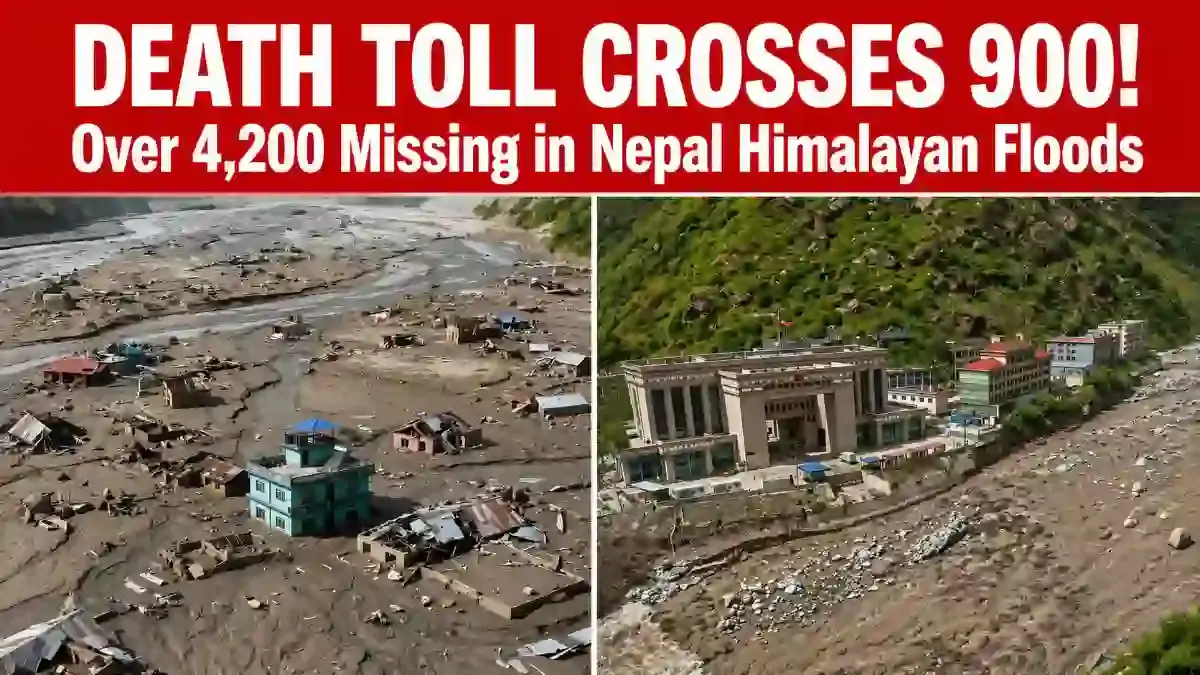

Nepal's Himalayan flash floods have claimed 903 lives and left over 4,200 missing along the Bhote Koshi and Trishuli rivers, as multi-national teams execute complex hydropower tunnel rescues amidst secondary surge warnings and upstream debris dam threats.
- Confirmed death toll reaches 903 across Nepal's Bhote Koshi and Trishuli river corridors.
- Over 4,247 people remain missing, including 933 trapped hydropower project personnel.
- Fresh evacuation alerts issued for Rasuwa, Nuwakot, and Dhading due to upstream debris lakes.
- Multi-national rescue teams from India, China, and South Korea deployed for sub-surface tunnel operations.
- MEA confirmed over 149 Indian nationals airlifted and roughly 600 pilgrims safely evacuated via land borders.
Kathmandu / New Delhi: The scale of devastation across central and northern Nepal escalated sharply on Monday as the official death toll from the catastrophic flash floods and debris flows along the Bhote Koshi and Trishuli river networks reached 903 confirmed fatalities, according to an emergency briefing by Nepal's National Disaster Risk Reduction and Management Authority (NDRRMA). Over 4,247 individuals remain missing or uncontactable, including hundreds of workers trapped inside subterranean hydropower tunnels, security personnel, and foreign pilgrims.
District-Wise Casualty Breakdown & Rescue Operations
Intense search and recovery missions continue along riverbanks and downstream gorges, where silt and boulder deposits have complicated emergency operations:
- Chitwan District: Remains the worst affected downstream area with 272 bodies recovered to date.
- Nawalparasi: Recorded 207 deaths in Nawalparasi (East) and 151 deaths in Nawalparasi (West).
- Central & Mountain Belts: Fatalities include 95 in Nuwakot, 62 in Gorkha, 55 in Dhading, 37 in Tanahun, and 24 in Rasuwa.
- Evacuations: Ground defense forces and multi-agency helicopter squadrons have successfully rescued and airlifted over 10,450 survivors from isolated mountainous pockets.
- Missing Breakdown: Unaccounted persons include 933 workers trapped across damaged hydropower infrastructure, 85 Nepalese security and customs officers, and approximately 590 foreign nationals, including Indian Kailash Mansarovar pilgrims.
Secondary Flood Surge & Unstable Debris Dams Upstream
Vulnerability across the mountain corridors remains critical following high-altitude hydrometeorological warnings:
- Transboundary Alerts: Hydrometeorological authorities in China notified Nepalese counterparts of surging water levels in the upper catchment of the Bhote Koshi due to persistent rainfall.
- Emergency SMS Evacuations: Automated disaster alerts were pushed directly to residents in Rasuwa, Nuwakot, and Dhading districts, instructing immediate evacuation to higher ridge terrain.
- Glacial & Landslide Lakes: Satellite assessments have mapped two temporary barrier lakes formed by massive avalanche debris along the border gorge, which remain unstable and present severe potential dam-breach hazards.
International Response and Sub-Surface Tunnel Extractions
Specialized disaster mitigation teams from India, China, and South Korea have been mobilized on-site, deploying ground-penetrating radar and heavy hydraulic equipment to breach blocked access shafts at submerged hydropower project sites where trapped workers are feared stranded.
India has dispatched specialized forensic and disaster identification squads to assist Nepalese agencies with DNA matching and rapid forensic processing. Meanwhile, India's Ministry of External Affairs (MEA) confirmed that over 149 Indian nationals have been airlifted to safety within Nepal, while approximately 600 pilgrims have crossed safely back via operational land checkpoints.
Frequently Asked Questions
Ketan
adminPassionate journalist and digital news editor committed to delivering accurate, timely, and fact-checked news.
Related Articles


Latest Articles

PM Modi Meets Putin and Pezeshkian at Bishkek SCO...
Aug 31, 2026
Zomato Bans Analogue Dairy Dishes in Nationwide Cr...
Aug 31, 2026
India Q1 GDP FY27 Surges to 7.8% Driven by Capex R...
Aug 31, 2026
PM Modi Conferred Uzbekistan's Highest Honour 'Ord...
Aug 30, 2026
Comments (0)
Leave a Comment
No comments yet. Be the first to comment!