
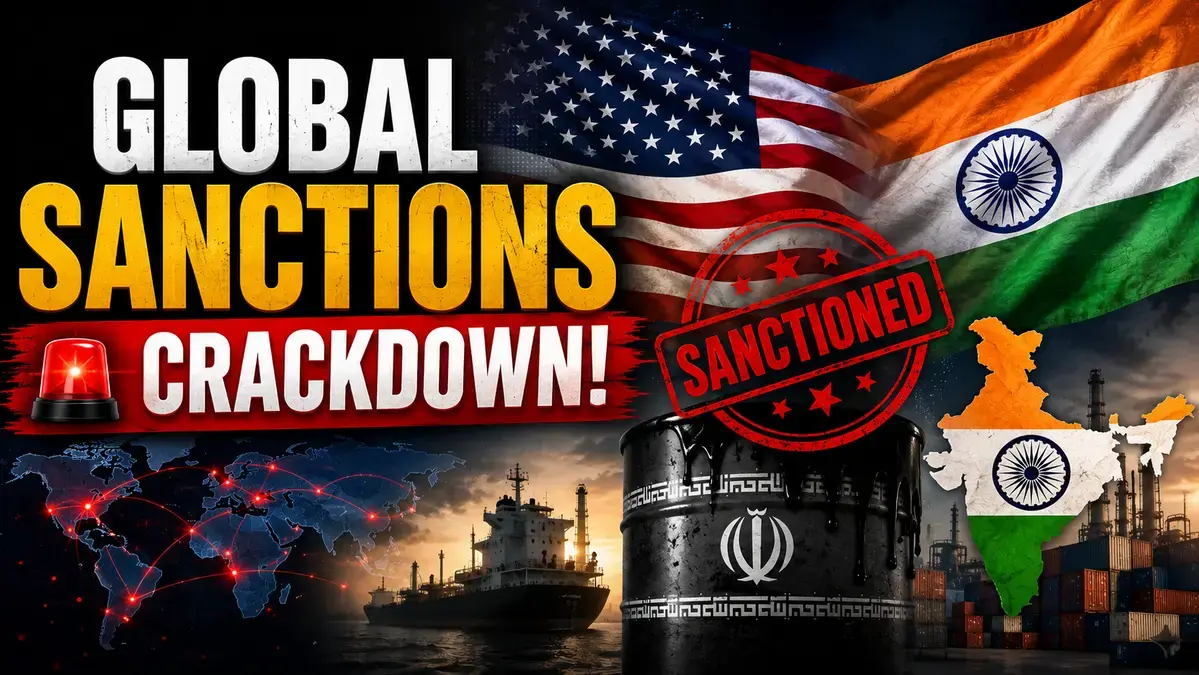

The United States has launched 'Operation Economic Outcast', imposing sweeping sanctions on nearly 60 global targets, including four India-based firms and three Indian nationals, for allegedly facilitating over $119 million in Iranian petroleum and petrochemical transactions.
- The US launched 'Operation Economic Outcast' targeting Iran's petroleum revenue and shipping networks.
- Four Indian companies and three Indian nationals were sanctioned for alleged imports worth $119 million.
- Targeted firms include Portease Partners LLP, Sadashiva Overseas, PP Softtech, and Prakrutees Infra Impex.
- The US Treasury sanctioned nearly 60 global entities, vessels, and individuals under Executive Orders 13846 and 13949.
Washington / New Delhi: In a major escalation of diplomatic and financial pressure on Tehran, the United States has unveiled a sweeping global sanctions blitz dubbed 'Operation Economic Outcast'. Moving away from direct kinetic confrontation in favor of comprehensive economic blockade, the US Department of the Treasury and the US Department of State have targeted international shadow-fleet operators, petrochemical brokers, and maritime logistics networks. As part of the crackdown, Washington designated four India-based companies and three Indian nationals for allegedly facilitating the purchase, transport, and import of Iranian-origin petroleum and petrochemical products worth an estimated $119 million. For ongoing coverage of international diplomacy, sanctions policy, and global energy markets, follow our global geopolitics desk.
The Four Indian Companies and Key Executives Designated
According to official releases from the US State Department and the Office of Foreign Assets Control (OFAC), the sanctioned Indian entities were penalised under Executive Orders 13846 and 13949 for knowingly engaging in significant transactions involving Iranian petroleum:
- Portease Partners LLP: An India-based customs brokerage firm accused of facilitating multiple import consignments of Iranian petrochemical products. Its partners, Indrismiya Ashrafmiya Sheikh and Harish Ramachandra Rangi, were individually designated as Indian nationals linked to the transactions.
- Sadashiva Overseas Limited: Designated for allegedly importing Iranian-origin petroleum products valued at approximately $69 million through intermediate trading conduits, including previously designated entities.
- PP Softtech Private Limited: Accused of importing approximately $25 million in Iranian petroleum products, with company director Prashant Garg named on the individual sanctions list.
- Prakrutees Infra Impex India Private Limited: Targeted for allegedly procuring approximately $25 million worth of petroleum and related petrochemical derivatives originating from Iran.
Scope of 'Operation Economic Outcast'
US Treasury Secretary Scott Bessent characterized Operation Economic Outcast as an aggressive campaign designed to dismantle Iran’s energy revenue channels, shadow tanker networks, and military procurement pipelines. Concurrently, the measures targeted nearly 60 foreign entities, individuals, and maritime vessels spanning China, Hong Kong, the UAE, and India.
The US administration warned that third-country entities continuing to trade in Iranian hydrocarbons face extensive secondary sanctions, including exclusion from US dollar-clearing systems, asset freezes, and severed access to the American financial grid.
Strategic Shifts and Diplomatic Posture
The punitive economic measures signal Washington’s reliance on coercive economic statecraft over direct military strikes to curb regional instability and choke off revenue streams. While US diplomatic missions across parts of the Middle East have begun gradual administrative restaffing, trade compliance analysts note that heightened scrutiny over transshipment routes in the Arabian Sea and Persian Gulf will require heightened due-diligence from Asian refiners, customs brokers, and chemical importers navigating international sanctions regimes.
Frequently Asked Questions
Ketan
adminPassionate journalist and digital news editor committed to delivering accurate, timely, and fact-checked news.
Related Articles


Latest Articles
Trump Renames Lake Ontario to 'Lake America' Amid...
Aug 28, 2026
Maharashtra Grants 1-Year Breather for Auto & Cab...
Aug 28, 2026
Raksha Bandhan 2026 Nationwide Celebrations Trains...
Aug 28, 2026
Chandra Grahan & Raksha Bandhan: Sutak Kaal Rules...
Aug 28, 2026
Comments (0)
Leave a Comment
No comments yet. Be the first to comment!